On this page
Callback hell
Last reviewed 14 Sept 2026
Callback hell in JavaScript occurs when multiple callbacks are nested inside each other, which creates complex and hard-to-manage code.
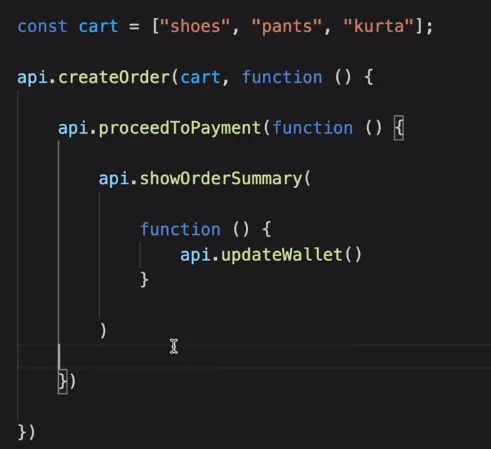
Callback hell (callback pyramid), also known as the “Pyramid of Doom”, is when nested callbacks lead to deeply indented, hard-to-read code. The code grows sideways and looks like a pyramid.
Example: an e-commerce order flow
Each step depends on the previous one, so each call is placed inside the previous callback:
const cart = ["shoes", "pants", "kurta"];
api.createOrder(cart, function (orderId) {  api.proceedToPayment(orderId, function (paymentInfo) {    api.showOrderSummary(paymentInfo, function (summary) {      api.updateWallet(summary, function () {        console.log("Order complete");      });    });  });});
Runnable version with setTimeout:
function step(name, callback) {  setTimeout(() => {    console.log(name + " done");    callback();  }, 500);}
step("Create order", () => {  step("Payment", () => {    step("Order summary", () => {      step("Update wallet", () => {        console.log("All steps finished");      });    });  });});
// Create order done// Payment done// Order summary done// Update wallet done// All steps finished
Problems with callback hell:
- Hard to read and maintain — the logic grows to the right instead of top to bottom.
- Error handling is repeated — every level needs its own error check.
- Inversion of control — explained below.
getUser(id, function (err, user) { if (err) return handleError(err); getOrders(user, function (err, orders) { if (err) return handleError(err); getInvoice(orders[0], function (err, invoice) { if (err) return handleError(err); console.log(invoice); }); });});Inversion of control
Inversion of Control (IoC) is a programming principle where the flow of control is managed by external code (a framework or library) instead of your own code.
In the order example, we give our callback to api.createOrder and trust it to call our function correctly. We lose control of our program and hand control of our callback over to another function. What if createOrder:
- never calls the callback?
- calls it twice (charging payment twice)?
- calls it too early, or with wrong data?
- throws an error that swallows our callback?
We can’t control any of this, because the callback is running inside someone else’s code.
Solution: Promises and async/await
Promises fix both problems: the code becomes a flat chain, and we attach the handlers to a promise object, which guarantees it resolves only once.
api.createOrder(cart) .then(orderId => api.proceedToPayment(orderId)) .then(paymentInfo => api.showOrderSummary(paymentInfo)) .then(summary => api.updateWallet(summary)) .then(() => console.log("Order complete")) .catch(err => console.error("Something failed:", err)); // one place for errorsWith async/await it reads like synchronous code:
async function placeOrder(cart) { try { const orderId = await api.createOrder(cart); const paymentInfo = await api.proceedToPayment(orderId); const summary = await api.showOrderSummary(paymentInfo); await api.updateWallet(summary); console.log("Order complete"); } catch (err) { console.error("Something failed:", err); }}The runnable step example converted to promises:
const stepP = (name) =>  new Promise(resolve => setTimeout(() => {    console.log(name + " done");    resolve();  }, 500));
stepP("Create order")  .then(() => stepP("Payment"))  .then(() => stepP("Order summary"))  .then(() => stepP("Update wallet"))  .then(() => console.log("All steps finished"));
Other ways to reduce nesting even with callbacks: use named functions instead of anonymous ones, and keep functions small. See the Promise chapter next.