On this page
Promise
Last reviewed 14 Sept 2026
A Promise is an object representing a value that is not necessarily known when the promise is created — the eventual completion (or failure) of an asynchronous operation. It lets you attach handlers for the operation’s eventual success value or failure reason. This lets asynchronous functions return something like synchronous functions do: instead of immediately returning the final value, they return a promise to supply the value at some point in the future.
Once a promise is settled (fulfilled or rejected), its state and value cannot change — it is immutable after settling. That’s why a promise can resolve only once.
A Promise is in one of these states:
- pending: initial state, neither fulfilled nor rejected.
- fulfilled: the operation completed successfully.
- rejected: the operation failed.
A promise that is fulfilled or rejected is called settled.
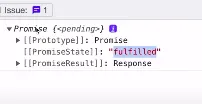
If you log a promise, it may initially show pending. When you expand it later in Chrome DevTools, Chrome shows the current state, so it can show fulfilled — the console updates the object when you expand it.
Creating and consuming a promise
function myDisplayer(some) {  document.getElementById("demo").innerHTML = some;}
let myPromise = new Promise(function (myResolve, myReject) {  let x = 0;
  // some code (try changing x to 5)  if (x == 0) {    myResolve("OK");  } else {    myReject("Error");  }});
myPromise.then(  function (value) { myDisplayer(value); }, // runs on resolve  function (error) { myDisplayer(error); }  // runs on reject);
The function passed to new Promise is called the executor. It runs immediately (synchronously) and receives two functions: resolve (call on success) and reject (call on failure).
A more common style uses .then for success and .catch for errors:
const wait = (ms) => new Promise((resolve) => setTimeout(() => resolve(`Waited ${ms}ms`), ms));
wait(1000)  .then(result => console.log(result))       // "Waited 1000ms"  .catch(error => console.error(error))  .finally(() => console.log("Always runs")); // "Always runs"
Promise execution order
console.log("1");
const p = new Promise((resolve) => {  console.log("2");   // executor runs synchronously  resolve("3");});
p.then(value => console.log(value)); // .then callbacks go to the microtask queue
console.log("4");
// Output:// 1// 2// 4// 3
A promise settles only once
const once = new Promise((resolve, reject) => {  resolve("first");  resolve("second"); // ignored  reject("error");   // ignored});
once.then(v => console.log(v)); // "first"
Promise chaining
Each .then() returns a new promise. Whatever you return from .then is passed to the next .then. If you return a promise, the chain waits for it.
new Promise(resolve => resolve(2)) .then(n => n * 2) // 4 .then(n => new Promise(r => setTimeout(() => r(n * 2), 500))) // waits → 8 .then(n => { console.log(n); // 8 });Common mistake — forgetting to return:
Promise.resolve(1) .then(n => { n * 2; }) // no return .then(n => console.log(n)); // undefinedError handling
An error thrown (or a rejection) anywhere in the chain skips to the nearest .catch:
Promise.resolve() .then(() => { throw new Error("Step 1 failed"); }) .then(() => console.log("never runs")) .catch(err => { console.log("Caught:", err.message); // "Caught: Step 1 failed" return "recovered"; }) .then(v => console.log(v)); // "recovered" — the chain continues after catchReal example: fetch
fetch returns a promise:
fetch("https://jsonplaceholder.typicode.com/users/1") .then(response => { if (!response.ok) throw new Error("HTTP " + response.status); return response.json(); // also returns a promise }) .then(user => console.log(user.name)) // "Leanne Graham" .catch(err => console.error("Request failed:", err.message));async / await
async/await is a cleaner syntax for working with promises. An async function always returns a promise. await pauses the function until the promise settles.
async function getUser() {  try {    const response = await fetch("https://jsonplaceholder.typicode.com/users/1");    if (!response.ok) throw new Error("HTTP " + response.status);    const user = await response.json();    console.log(user.name);  } catch (err) {    console.error("Request failed:", err.message);  }}
getUser();
async function getNumber() {  return 42;}console.log(getNumber());               // Promise { 42 }getNumber().then(n => console.log(n));  // 42
Promise combinators
const fast = new Promise(r => setTimeout(() => r("fast"), 100));const slow = new Promise(r => setTimeout(() => r("slow"), 500));const fail = new Promise((_, reject) => setTimeout(() => reject("failed"), 300));| Method | Resolves when | Rejects when |
|---|---|---|
Promise.all | all fulfill → array of values | any rejects (fails fast) |
Promise.allSettled | all settle → array of {status, value/reason} | never |
Promise.race | the first to settle fulfills | the first to settle rejects |
Promise.any | the first to fulfill | all reject (AggregateError) |
Promise.all([fast, slow]).then(console.log);        // ["fast", "slow"] (after 500 ms, order kept)Promise.all([fast, fail, slow]).catch(console.log); // "failed" (after 300 ms)
Promise.allSettled([fast, fail]).then(console.log);// [{ status: "fulfilled", value: "fast" }, { status: "rejected", reason: "failed" }]
Promise.race([slow, fail]).catch(console.log);      // "failed" — settled firstPromise.any([fail, slow]).then(console.log);        // "slow" — first to fulfill
Sequential vs parallel with await:
const delay = (ms, v) => new Promise(r => setTimeout(() => r(v), ms));
async function sequential() {  const a = await delay(1000, "a"); // waits 1 s  const b = await delay(1000, "b"); // waits another 1 s  return [a, b];                    // total ~2 s}
async function parallel() {  const [a, b] = await Promise.all([delay(1000, "a"), delay(1000, "b")]);  return [a, b];                    // total ~1 s}
Interview questions
// Q1: Output?console.log("A");setTimeout(() => console.log("B"), 0);Promise.resolve().then(() => console.log("C"));console.log("D");// A, D, C, B — sync first, then microtasks (promises), then tasks (setTimeout)// Q2: Output?const p1 = new Promise((resolve) => { console.log("inside executor");});console.log(p1); // Promise { <pending> } — resolve was never called// Q3: Promisify a callback-style functionfunction promisify(fn) { return (...args) => new Promise((resolve, reject) => { fn(...args, (err, result) => (err ? reject(err) : resolve(result))); });}
function oldApi(x, cb) { setTimeout(() => cb(null, x * 2), 100); }promisify(oldApi)(21).then(console.log); // 42// Q4: Polyfill for Promise.allfunction promiseAll(promises) { return new Promise((resolve, reject) => { const results = []; let completed = 0; if (promises.length === 0) return resolve([]);
promises.forEach((p, i) => { Promise.resolve(p) .then(value => { results[i] = value; // keep the original order completed++; if (completed === promises.length) resolve(results); }) .catch(reject); // reject on the first failure }); });}
promiseAll([1, Promise.resolve(2), new Promise(r => setTimeout(() => r(3), 100))]) .then(console.log); // [1, 2, 3]