On this page
JavaScript Engine
Last reviewed 14 Sept 2026
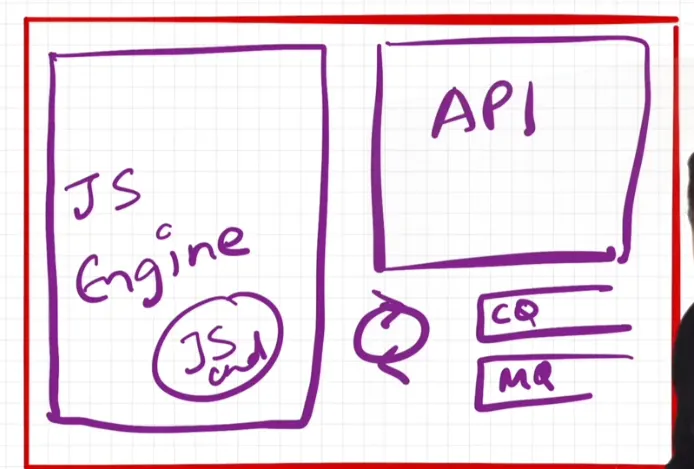
A JavaScript engine is a program that executes JavaScript code by converting it into machine code the computer understands. JavaScript engines in different environments:
- V8 — Google Chrome, new Microsoft Edge, and Node.js. Written in C++.
- SpiderMonkey — Firefox. It was the first JavaScript engine (created by Brendan Eich at Netscape).
- JavaScriptCore — Safari.
- Chakra — the old (legacy) Microsoft Edge and Internet Explorer.
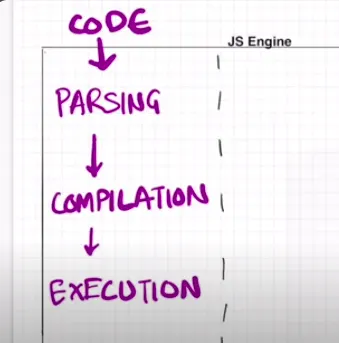
A JavaScript engine is not a machine — it is just a program written in a high-level language (like C++). JavaScript code goes through 3 major steps inside it:
- Parsing
- Compilation
- Execution
1. Parsing phase
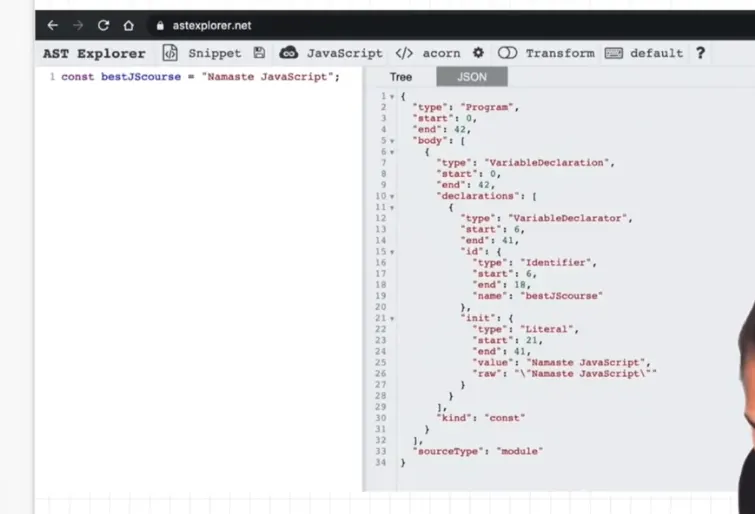
During parsing, the code we have written is broken down into tokens.
let a = 7; // tokens: let, a, =, 7, ;Syntax parser: takes the tokens and converts them into an AST (Abstract Syntax Tree) — a tree structure representing the code. Syntax errors are found at this stage, which is why a SyntaxError stops the whole script before any line runs.
(You can explore the AST at astexplorer.net.)
2. Compilation and 3. Execution phase
- Interpreter: reads the code and executes it line by line, without compiling first. It starts running quickly, but the code runs slower.
- Compiler: compiles the whole code before executing it, generating optimized machine code. It takes time up front, but the resulting code runs much faster.
So interpreted code starts faster, while compiled code runs faster and more efficiently.
JavaScript can behave like both a compiled and an interpreted language — it depends on the JS engine. When JavaScript was first created it was meant to be interpreted, but modern engines use a JIT (Just-In-Time) compiler, which combines an interpreter and a compiler. That’s why the compilation and execution phases go hand in hand.
After parsing, the AST goes to the interpreter, which converts the high-level code into bytecode and starts executing it. While the code runs, the engine watches for “hot” code (functions called many times) and sends it to the optimizing compiler, which generates highly optimized machine code at runtime. That’s why it is called Just-In-Time compilation. If an assumption turns out wrong (e.g. a function suddenly receives a string instead of a number), the engine de-optimizes back to bytecode.
In V8, the interpreter is called Ignition and the optimizing compiler is called TurboFan.
Execution uses 2 main components: the call stack and the memory heap.
- Call stack — keeps track of execution contexts (which function is running).
- Memory heap — where objects, arrays and functions are stored. The garbage collector frees memory in the heap that is no longer reachable, using the Mark and Sweep algorithm.
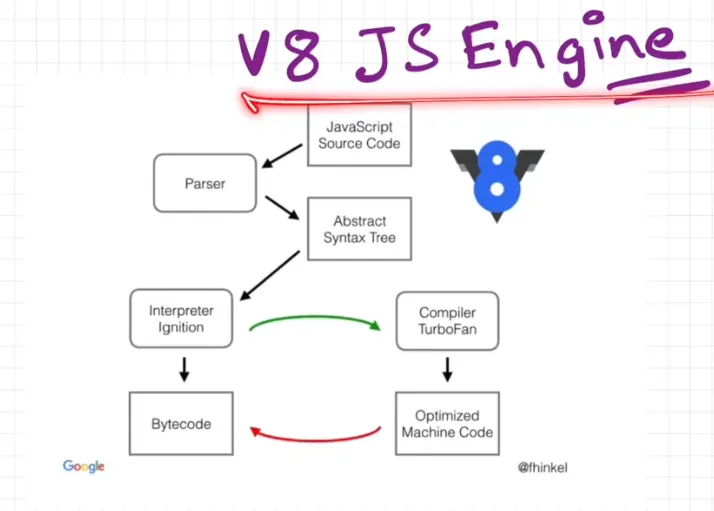
From a high-level view, V8 execution consists of 5 steps:
- Initialize the environment in the host (browser or Node.js)
- Parse and compile the JavaScript code
- Generate bytecode
- Interpret and execute the bytecode
- Optimize frequently used code into machine code for better performance
Write optimization-friendly code:
function add(a, b) {  return a + b;}
for (let i = 0; i < 100000; i++) add(i, i); // always numbers → V8 optimizes add
add('x', 'y'); // different types → may cause de-optimization
Mark and Sweep algorithm
Any garbage collection algorithm must do 2 basic things:
- Detect all unreachable objects.
- Reclaim the heap memory used by those objects, making it available to the program again.
Mark and Sweep does this in two phases:
- Mark phase
- Sweep phase
Mark phase
When an object is created, its mark bit is set to 0 (false). In the mark phase, the mark bit of every reachable object (objects the program can still refer to) is set to 1 (true). This is a graph traversal — for example depth-first search. Each object is a node, and from each node we visit all objects it references, until every reachable node has been visited.
A root is a variable that refers to an object and is directly accessible — e.g. global variables and local variables on the current call stack. Here we assume there is only one root.
We access the mark bit of an object with markedBit(obj).
Algorithm — Mark phase:
Mark(root) If markedBit(root) = false then markedBit(root) = true For each v referenced by root Mark(v)Note: if there is more than one root, call Mark() for every root.
Sweep phase
As the name suggests, it “sweeps” (clears) the unreachable objects: every object whose mark bit is still false is removed from the heap. For reachable objects (mark bit true), the mark bit is reset to false, so that the next time the garbage collector runs, it can mark reachable objects again from scratch.
Algorithm — Sweep phase:
Sweep() For each object p in heap If markedBit(p) = true then markedBit(p) = false else heap.release(p)The mark-and-sweep algorithm is called a tracing garbage collector, because it traces the entire collection of objects that are directly or indirectly reachable by the program.
let user = { name: 'Asha' }; // object reachable through `user`let admin = user;             // two references
user = null;                  // still reachable through adminadmin = null;                 // no references left → unreachable → collected in the next GC
// Cyclic references are handled toofunction makeCycle() {  const a = {};  const b = {};  a.ref = b;  b.ref = a;                  // a and b point to each other}makeCycle();                  // after it returns, neither is reachable from a root → both collected
Advantages of Mark and Sweep
- It handles cyclic references. Even with a cycle, the algorithm never ends up in an infinite loop (already-marked objects are skipped), and unreachable cycles are collected.
- There is no extra cost while the program runs normally (e.g. no reference counters to update on every assignment).
Disadvantages of Mark and Sweep
- Normal program execution is paused while the garbage collector runs (“stop-the-world”). Modern engines reduce this with incremental and concurrent GC.
- After running many times, reachable objects end up separated by many small unused memory gaps (fragmentation). Engines use compaction to fix this.
Copy elision
Copy elision is a compiler optimization (mainly a C++ concept) that avoids making unnecessary copies of objects, for example when returning an object from a function by value. It is not something you control in JavaScript — objects are already passed by reference — but engines written in C++ (like V8) benefit from it internally.
Inline caching
Let’s look at this code:
function printUserName(user) {  return `Hello ${user.firstName} ${user.lastName}`;}
const userName = {  firstName: 'John',  lastName: 'Doe'};
for (let i = 0; i < 10000; i++) {  printUserName(userName);}
We create a function that takes an object and returns a template string, then call it many times with objects that have the same structure.
Reading a property like user.firstName normally requires the engine to look up where firstName is stored inside the object. V8 gives every object a hidden shape (also called a hidden class) based on its properties and their order. The first time printUserName runs, V8 looks up firstName and lastName normally and caches where they are located for that shape. On the next calls, if the object has the same shape, V8 skips the lookup and reads the value directly from the cached location. This is called inline caching, and it makes repeated property access much faster.
Note: inline caching caches where the property is, not the result of the function. If userName.firstName changes, the function still returns the new value.
How to write inline-cache-friendly code:
// Good — same properties, same order → same shapeconst u1 = { firstName: 'John', lastName: 'Doe' };const u2 = { firstName: 'Jane', lastName: 'Roe' };
// Bad — different order or added later → different shapes, slower lookupsconst u3 = { lastName: 'Roe', firstName: 'Jane' };const u4 = { firstName: 'Max' };u4.lastName = 'Moe';- Create objects with the same properties in the same order (constructors or classes help).
- Avoid adding or deleting properties after creation (
deletechanges the shape).